At a glance
- Kids’ brains are still wiring up the systems for attention, planning, and self-control through the teen years; how (and when) they use phones matters. National Institute of Mental Health PMC
- There isn’t a single magic “safe hours” number; the quality, context, and tradeoffs (sleep, movement, face-to-face time) matter most. AAP
- Simple family habits—like a phone-free dinner routine, bedtime device basket, and a family media plan—reduce friction and help kids learn healthy tech use. (AAP Family Media Plan). HealthyChildren.org
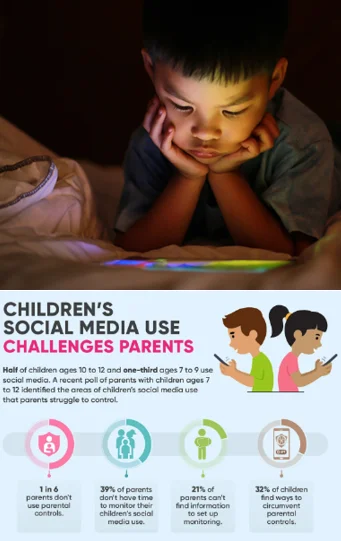
Why brain development makes phone habits a big deal
The prefrontal cortex—the brain area behind the forehead that steers planning, impulse control, and decision-making—keeps maturing into the mid-to-late 20s. That’s why guidance and boundaries matter during the years when kids and teens are still building those skills. National Institute of Mental Health PMC


Plain-English takeaway: Phones aren’t “bad,” but unlimited, late-night, or unsupervised use can crowd out sleep, movement, reading, and in-person time—core ingredients the developing brain needs.
Neuroscience research published in JAMA Pediatrics has found that children who spend more than two hours per day on screens score lower on thinking and language tests. More telling, MRI studies show structural differences in the brains of children who use devices heavily — particularly in the cortex, the brain’s outermost layer responsible for critical thinking and processing sensory information. These differences do not necessarily mean permanent harm, but they do underscore that screen time is not neurologically neutral during the developmental window.
The brain’s reward circuitry is also highly sensitive during adolescence. Social media platforms and many games are deliberately designed to deliver variable reward signals — the same neurological mechanism that makes gambling compelling. For a developing brain still learning to regulate impulse and delay gratification, this represents a genuine challenge. Research from the National Institutes of Health’s Adolescent Brain Cognitive Development (ABCD) study found that teens who used social media more than three hours per day were significantly more likely to report symptoms of anxiety and depression, particularly among girls.
This does not mean the goal is zero screen time. Technology use that involves creation (coding, writing, art), communication with family, or structured educational content engages the prefrontal cortex actively. The concern is passive, unpaced, and late-night consumption that displaces essential developmental activities. As a grandparent or parent figure, understanding this distinction helps you set boundaries that are grounded in science rather than just instinct.
Sleep first: the non-negotiable brain fuel
U.S. sleep experts recommend 9–12 hours for ages 6–12 and 8–10 hours for ages 13–18. If phones nibble into that window (homework scrolling, group chats, gaming), attention, mood, and learning can suffer. (CDC summary). CDC

Parent move: Create digital bedtime hygiene—devices parked outside bedrooms, night mode enabled, and a consistent lights-out. It’s easier if the whole family does it.
The mechanism behind phone-disrupted sleep is well established. Screens emit blue-wavelength light that suppresses melatonin production — the hormone that signals the brain it’s time to sleep. Even 30 minutes of screen exposure close to bedtime can delay melatonin onset by 90 minutes or more, according to research from Harvard’s Division of Sleep Medicine. For children and teens, whose circadian rhythms are already shifting later during puberty, this compounds the problem significantly.
Beyond light exposure, the psychological arousal from social media — checking likes, reading comments, following conversations — keeps the nervous system in a mild fight-or-flight state that is incompatible with the relaxed transition into sleep. A 2023 CDC report found that only about 22% of U.S. high school students get the recommended 8 hours of sleep on school nights, and researchers consistently point to phone use as a major contributing factor.
The practical solution is simple but requires consistency: a household rule that all devices — including parents’ phones — charge outside bedrooms from one hour before bedtime until morning. Children are more likely to accept this rule when they see adults following it too. An inexpensive alarm clock eliminates the “I use my phone as an alarm” justification. Families who implement this single change often report dramatic improvements in children’s morning mood, school performance, and ease of waking within two to four weeks.
“How much screen time is okay?”
The American Academy of Pediatrics (AAP) doesn’t give a one-size-fits-all number for school-age kids and teens; instead, it asks families to balance screen use with sleep, school, physical activity, and social life. (AAP: Screen Time Guidelines). AAP
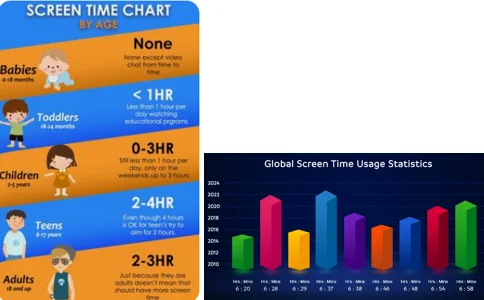
For toddlers and preschoolers, public-health guidance is stricter. The WHO suggests no screen time for babies under 1 and ≤1 hour/day for ages 2–4, with less being better and lots of active play and good sleep. (WHO news brief • WHO PDF). World Health Organization
One useful reframe for families is to think of screen time in terms of what it replaces rather than just how long it lasts. An hour of video-chatting with a grandparent is very different from an hour of autoplay videos, even though both register as “one hour of screen time.” The former involves turn-taking, emotional connection, and language development; the latter is largely passive. Similarly, a child who completes homework, eats dinner with the family, exercises outdoors, and then spends an hour gaming before a full night’s sleep is in a very different situation than one who skips all of the above.
Practical tools help make the abstract concrete. Many smartphones and tablets now have built-in screen time trackers (Screen Time on iOS, Digital Wellbeing on Android) that show exactly how apps are being used — which category, which specific apps, and at what times of day. Reviewing this data together with a child or teen, without shame or blame, often opens more productive conversations than a blanket time limit and creates a shared understanding of where the hours are actually going.
When is a child “ready” for a smartphone?
Readiness is more about maturity than age. The AAP suggests setting clear rules, remembering that a phone doesn’t automatically mean social media, and considering a contract that parents and kids sign together. (AAP: Age to introduce a mobile device). For a printable agreement, see Common Sense Media’s Family Media Agreement. AAP Safer Schools Together
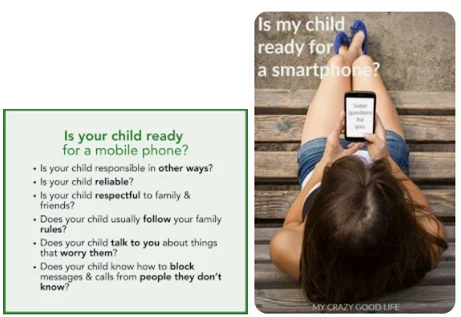
A useful checklist before introducing a smartphone includes: Can the child consistently follow household rules without reminders? Do they demonstrate basic responsibility with belongings (not losing things, completing chores)? Can they handle peer pressure and make decisions independently? And critically — are the parents prepared to supervise the device, monitor usage, and have ongoing conversations about what the child encounters online? If the answer to the last question is no, the family is not yet ready regardless of the child’s age.
Starting with a “dumb phone” — a device that can only call and text — or a GPS-only smartwatch is a genuinely effective intermediate step. These options address the safety concern (being reachable) without opening the social media and internet rabbit holes that most parents are actually worried about. Many families who try this approach find the transition to a smartphone at 13–14 goes much more smoothly because the child has already demonstrated they can handle digital responsibility at a lower level.
A written phone agreement signed by both parent and child turns abstract expectations into concrete commitments. It should cover: which apps are permitted, what the charging location is at night, what happens if grades drop or mental health struggles appear, and how the agreement will be revisited and updated over time. This shared ownership reduces the perception that rules are arbitrary punishments and frames phone use as a privilege that comes with responsibility.
Practical habits that actually stick (low-friction, low-drama)
1) Build a Family Media Plan
Use the free AAP plan to pick device-free zones (dinner table, car before school), set wind-down times, and define consequences you can actually enforce. HealthyChildren.org
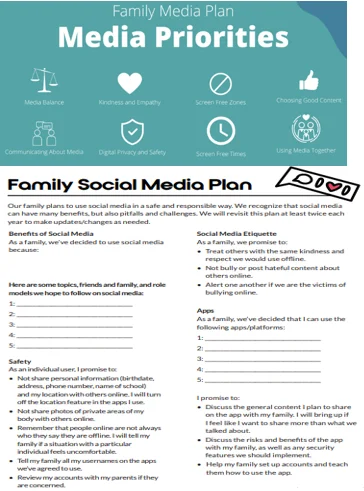
The reason structured plans work better than ad-hoc rules is that they eliminate daily negotiations. When a rule is written down and agreed upon, “the plan says no phones at dinner” is a much less contentious statement than “I’m telling you to put your phone away.” This is especially important in households with grandchildren visiting — having a visible, agreed-upon family plan makes temporary caregivers feel confident enforcing boundaries without seeming like the bad guy.
Device-free zones also protect the quality of family interaction in ways that benefit children cognitively. Research published in Child Development found that even the presence of a phone on a table — not being used, just visible — reduced the depth of conversation between people and lowered feelings of connection. The implication is that phone-free meals are not just about limiting screen time; they actively enhance the quality of family bonding that supports emotional development in children.
2) Use age-appropriate tech
For younger kids, start with a basic phone, kid smartwatch, or a “dumb” phone—then graduate slowly. (See Time guide to kids & phones for what experts recommend.) TIME
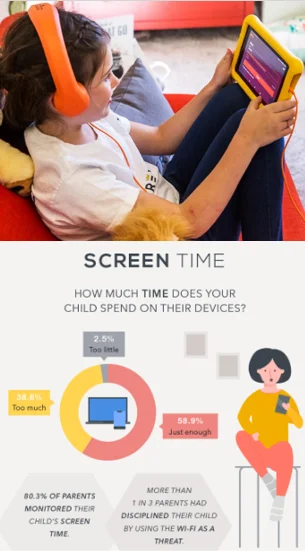
Built-in parental controls have improved dramatically and are worth using fully. On iOS, Screen Time (under Settings) allows parents to set per-app daily limits, schedule downtime windows (e.g., 9 PM to 7 AM), restrict content by age rating, prevent app purchases, and even lock communication to approved contacts only. On Android, Google Family Link provides similar features plus location sharing. These tools work best when set up together with the child rather than in secret — transparency builds trust and teaches self-regulation rather than just enforcing external control.
3) Create homework focus windows
Silence notifications during study blocks and keep the phone off the desk; many families like a kitchen charging station.
Research on multitasking consistently shows that switching between a task and a phone notification — even briefly glancing at a notification — costs an average of 23 minutes to fully return to deep focus. For a student trying to complete an hour of homework, this means that just three interruptions can effectively extend the work period to nearly two hours of fragmented effort. A simple rule — phone in a different room during homework time — often cuts homework time in half and dramatically reduces the frustration that leads to homework avoidance.
4) Protect sleep
Establish a bedtime device basket outside bedrooms. Cross-check sleep needs by age at the CDC. CDC
5) Align with school rules
Ask about your district’s phone policy and echo it at home so kids aren’t getting mixed messages. (AAP resource for school phone policies). AAP
Age-by-age guide (keep it simple)
Under 2: Prioritize play, talk, and sleep. If you video chat with grandparents, sit with your child and narrate what’s happening. (AAP on infants & screens). AAP
Ages 2–5: If you use screens, keep them short, co-view, and pick quality content. WHO suggests ≤1 hour/day, with plenty of active play and naps. (WHO guidance). World Health Organization
Ages 6–12: Focus on sleep, homework focus, and kind online behavior. Try a “no phones before school” rule on weekdays.
Teens: Co-create boundaries: where phones sleep, when DND turns on, and what happens if grades or mood drop. Reinforce that good sleep (8–10 hours) beats late-night scrolling. (CDC teen sleep basics). CDC
One of the most effective techniques across age groups is the concept of “digital sunsets” — a consistent, household-wide wind-down starting 60–90 minutes before bed during which screens are progressively dimmed, then put away. This mirrors the natural dimming of light at dusk that human circadian rhythms evolved to respond to. Families who implement digital sunsets report that children fall asleep faster, wake less during the night, and are noticeably more pleasant in the mornings — often within the first week.
Eye comfort & posture quick wins
Encourage the 20-20-20 rule (every 20 minutes, look 20 feet away for 20 seconds), blink often, keep screens below eye level, and use daylight breaks. See the American Academy of Ophthalmology’s tips. American Academy of Ophthalmology
Myopia (nearsightedness) rates have risen sharply among children in recent decades, and ophthalmologists now point to both screen time and reduced outdoor time as contributing factors. Studies from Asia, where screen use is particularly high among children, show myopia prevalence approaching 80–90% in urban teenagers. Outdoor light exposure — at least two hours daily — appears to be protective, with research suggesting it stimulates dopamine release in the retina that slows the elongation of the eyeball that causes myopia. This means encouraging outdoor play is not just about exercise; it is directly relevant to your child’s lifelong vision.
Posture is an underappreciated concern. “Tech neck” — the forward-head posture that develops from looking down at phones — places up to 60 pounds of effective force on the cervical spine when the head is tilted 60 degrees forward (roughly typical smartphone-reading posture). Over years, this can contribute to muscle tension headaches, early disc wear, and rounded shoulders that affect breathing and self-confidence. The practical fix is simple: hold devices at eye level, use table stands for tablets, and teach children to recognize and self-correct the forward-head position.
Q&A (concise, factual)
-
Does smartphone use change a child’s brain?
Phones themselves aren’t magic wands; what matters is what they replace. Healthy routines (sleep, exercise, reading, family time) support brain development; chaotic routines can undercut it. National Institute of Mental Health -
Is there a “safe” screen-time number for school-age kids?
No single number. Create a family plan that protects sleep, schoolwork, and relationships. (AAP overview). AAP -
How much sleep do kids really need?
Ages 6–12: 9–12 hours; ages 13–18: 8–10 hours—every day. (CDC summary). CDC -
What about toddlers and preschoolers?
Under 1: avoid screen time; ages 2–4: keep it ≤1 hour/day, and less is better. (WHO guideline). World Health Organization -
When should my kid get their first phone?
When they show responsibility and you’re ready to supervise. Start with limited features and a written agreement. (AAP guidance). AAP -
Do blue-light filters solve bedtime problems?
Filters help a bit, but the bigger win is no phones in bedrooms and a wind-down routine that protects sleep hours. (CDC sleep guidance). CDC -
Should phones be allowed at school?
Follow your school’s policy and mirror it at home. Consistency reduces arguments and FOMO. (AAP school-policy resource). AAP -
Is educational content okay for little kids?
Co-viewing short, high-quality content is better than solo viewing. Active play and sleep still come first. (Mayo Clinic overview). Mayo Clinic -
Where can I get a free family phone contract?
Download a Family Media Agreement (printable checklists by grade band). Safer Schools Together -
My child “needs” a phone for safety. Any middle ground?
Try a watch phone or basic phone first; add features gradually as your child shows readiness. (Expert roundup). TIME -
What’s one habit that pays off fast?
A phone-free dinner routine—short, daily, and great for connection and manners. (AAP Family Media Plan). HealthyChildren.org -
Are U.S. kids sleeping enough?
Many aren’t. Protecting sleep is one of the best things you can do for mood, attention, and learning. (CDC quick stats). CDC
Quick-start checklist for parents (bookmark this)
- Set where phones sleep (outside bedrooms).
- Make a family media plan and print a phone agreement. (AAP plan • Common Sense Media agreement). HealthyChildren.org Safer Schools Together
- Use built-in tools: Apple Screen Time / Google Family Link for app limits, downtime, and content filters.
- Protect eye comfort with short, regular breaks. (AAO tips). American Academy of Ophthalmology
- Revisit rules every quarter; adjust as your child matures.
Helpful resources
- AAP Family Media Plan – customizable, free: https://www.healthychildren.org/English/fmp/Pages/MediaPlan.aspx
- AAP: Screen Time Guidelines (Q&A) – why there’s no single number: AAP
- CDC: Sleep by Age – U.S. guidance for children & teens: https://www.cdc.gov/physical-activity-education/staying-healthy/sleep.html
- NIMH: The Teen Brain – plain-English science: https://www.nimh.nih.gov/health/publications/the-teen-brain-7-things-to-know
- WHO: Under-5 screen time & sleep – global baseline: WHO PDF
- AAO: Screen use & eyes – practical tips: https://www.aao.org/eye-health/tips-prevention/screen-use-kids
- Common Sense Media: Family Contract (printable): https://saferschoolstogether.com/common-sense-media-digital-contract/
Final word
Phones are a reality of modern childhood. With steady routines, age-appropriate access, and open conversations, you can help your child build lifelong, healthy tech habits—without power struggles.
For grandparents and older family members who sometimes watch the grandchildren, the good news is that the most effective strategies are also the simplest: eat meals together without devices, enforce a regular bedtime, keep chargers in common areas, and make outdoor time a non-negotiable part of the day. You don’t need to be tech-savvy to implement the habits that matter most. Consistent, calm boundaries — even when kids push back — are among the most loving gifts you can offer a developing brain.
⚕️ Medical Disclaimer
The information provided on this page is for educational purposes only and is not intended as medical advice, diagnosis, or treatment. Always consult a qualified healthcare professional before making changes to your diet, starting any supplement, or if you have an existing medical condition. KeepFitQuote does not provide medical diagnoses or treatment recommendations. Read our full disclaimer.
Related Posts